


Date: 2026-1-23

Category: Metallurgical encyclopedia terms

Views: 408
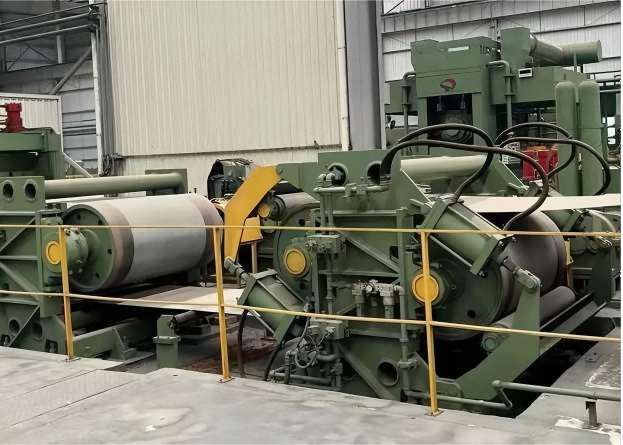
Tension levellers are core equipment in industries such as iron and steel metallurgy and non-ferrous metal processing. They are mainly used for shape correction and performance optimization of strip steel, plates, and other profiles.
By combining tension application with bending levelling, tension levellers eliminate internal residual stress, improve flatness defects, and provide high-quality blanks for subsequent rolling and finishing processes. They are widely applied in the production of:
The core process logic of a tension leveller lies in the composite effect of “tension yield + bending levelling.”
First, the tension device applies axial tension to the material, bringing internal stress close to the yield limit and breaking the original stress balance.
Subsequently, the material passes through multiple groups of staggered upper and lower levelling rolls. During continuous bending, surface and internal fibers undergo repeated tensile and compressive deformation, achieving uniform residual stress distribution.
The tension value is adjusted according to material properties, thickness, and strength grade.It is generally set at 15%–40% of the material’s yield strength, ensuring stress penetration without excessive stretching.
Bending curvature is controlled by adjusting:
This allows the equipment to adapt to different shape defects, such as:
For severe shape defects, multiple levelling passes are required to gradually optimize stress distribution and avoid material damage caused by excessive deformation in a single pass.
By coordinating temperature and tension, levelling efficiency is improved while reducing levelling force consumption.
As the power core of the levelling process, tension generation devices are mainly divided into:
The mechanical type uses motor-driven tension rolls and transmits tension through surface friction. It features simple structure and easy maintenance, suitable for medium and low-strength materials.
The hydraulic type controls the tension cylinder via a hydraulic system, enabling precise closed-loop tension control with fast response, making it suitable for high-strength and high-precision materials.
Tension roll surfaces are usually rubber-coated or plasma-sprayed to enhance friction and prevent surface scratching.
The levelling roll system is the core working unit, consisting of staggered upper and lower roll rows. The upper rolls can be lifted and adjusted through hydraulic or mechanical mechanisms.
Key design requirements include:
1.Roll diameter and roll number matching
Some high-end systems feature quick-change roll units, improving production flexibility for different material widths and thicknesses.
The transmission system typically uses a variable-frequency motor + reducer configuration.
Through PLC control, synchronous operation of tension rolls and levelling rolls is achieved, ensuring speed matching and preventing uneven stretching.
The control system integrates:
Real-time tension data from sensors is combined with shape meter feedback to automatically adjust tension and roll reduction, forming a closed-loop control of “detection – analysis – adjustment.”
Auxiliary devices include:
These components ensure accurate material positioning, improved discharge flatness, edge protection for thin strips, and reduced roll wear while controlling process temperature.
Through the deep coordination of process control and equipment design, tension levellers integrate shape correction and performance optimization in one system. Their technical level directly determines the dimensional accuracy and service performance of final products.
With the advancement of intelligent manufacturing, intelligent tension levellers featuring online monitoring, parameter self-optimization, and remote diagnostics have become the industry trend, providing strong support for high-quality production in iron and steel metallurgy.

Phone


Address


